Hammock Park: A Complete Guide to Dunedin’s 90-Acre Wild Heart
In the middle of Dunedin, surrounded by neighborhoods and a few blocks from downtown, there is a 90-acre nature preserve that most people who visit the city never see. Tourists go to Honeymoon Island. Day-trippers walk the Pinellas Trail through downtown and stop at the breweries. Residents bring their bikes to the waterfront. Hammock Park is the place that locals know about, that visitors stumble onto by accident if they stumble onto it at all, and that, once you spend any real time in it, becomes one of the reasons you understand why this town is the way it is.
I have lived in Dunedin since 2013, and I run and walk through Hammock Park every single week. It is one of my favorite places in this town, and over the years it has become part of the rhythm of how I live here. I see friends and neighbors on the trails. I watch the seasons turn in the canopy. I have come to know which trails take me through which habitats, and which benches sit in which kind of light at which time of day. This piece is meant to be a complete guide to Hammock Park, the kind of thing I wish had existed when I first started exploring the park more than a decade ago. The history. The wildlife. The trails. The Friends of the Hammock who keep it all running. And the deeper connection between this park and the natural history of Dunedin itself, which a man named Willis Stanley Blatchley was writing about a century ago from a platform in an oak tree across town.
If you want to start broad and zoom in, see Parks in Dunedin Florida Complete Guide for the survey of the city’s full parks system. If you want to understand the chapel that sits at the entrance to Hammock Park and how that chapel became the founding cause of the Dunedin Historical Society, see my piece on Andrews Memorial Chapel. And if you want the larger story of the town that surrounds the park, see the Ultimate Guide to Dunedin Florida.
This piece is Hammock Park itself.
How Hammock Park Became Hammock Park
The park exists because of a man named Ken Kerr who changed his mind about what to do with a piece of land.
Hammock Park’s history as a city-owned parcel began in 1965, when local attorney Ken Kerr sold 85 acres to the City of Dunedin. The land had a longer story behind that sale. In the 1920s, like much of Florida during the boom era, the property had been platted for residential development. Mosquito ditches had been dug across the wetlands, part of the now-discredited theory that you could solve a mosquito problem by digging channels to float the larvae out to sea. The scars from those ditches are still visible on aerial maps today.
Kerr had purchased the land some time after 1931 with the intention of continuing the development plans the 1920s had laid out. The intention did not survive the land itself. As he walked the property and got to know it, he fell in love with what was actually there, the hardwood hammock and the pine groves and the mangrove swamp and the bayheads and the patchwork of distinct habitats packed into one small piece of Florida. Instead of developing it, he decided to preserve it. He sold the 85 acres to the city.
A few years later, in 1972, additional adjacent land brought the park closer to its current size. The Wikipedia entry lists it as approximately 90 acres. The City of Dunedin describes it as 90 acres. The Friends of the Hammock have used 98 acres in some materials. The most recent description from a knowledgeable local source puts it at 96 acres. The exact figure depends on where you draw the boundaries and what counts. What is clear is that this is the largest natural area within the city limits of Dunedin and one of the most ecologically diverse pieces of land in this part of Florida.
The land that Ken Kerr decided to preserve in 1965 is, six decades later, one of the defining pieces of public ground in the City of Dunedin. The park exists because one person changed his mind, and because a city was willing to receive what he chose to give.
In 2017, the city acquired an additional eight acres adjacent to the park, the former Faith Lutheran Church property, which protected critical gopher tortoise habitat that had been identified by mapping surveys. That kind of incremental expansion, decades after the original founding, is what keeps a park like this one viable across generations rather than letting it shrink.
What Is Actually in There
Hammock Park is unusual for the variety packed into its size.
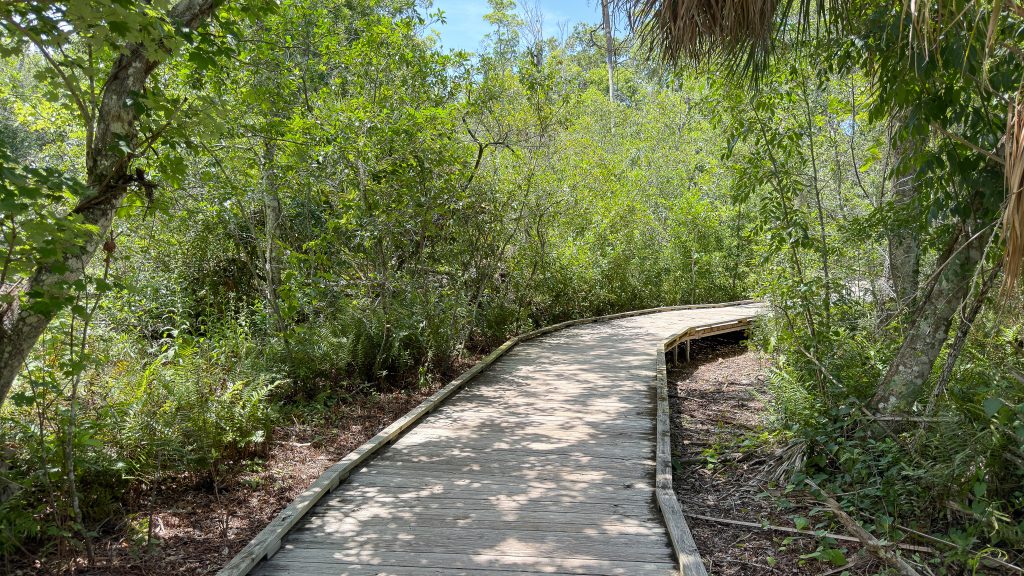
The 90 acres include hardwood hammock as the dominant habitat, with dark, rich soil that supports a denser and more varied vegetation than the surrounding sandy uplands. Some of the hardwoods are 100-year-old trees, with diameters up to three feet. The tallest trees, reaching 80 to 90 feet, are Sweetbays, which are becoming increasingly rare as they succumb to age, drought, and invasive vines. Beyond the hardwood hammock, the park includes pine groves, a mangrove swamp, tidal creeks, canals, a small lake, and remnant sand pine scrub. The Florida Birding Trail describes the park as encompassing bayheads and hydric hammock, plus pine groves, a mangrove swamp, tidal creeks, canals, a lake, and a remnant section of sand pine scrub. Florida Hikes describes the park as a “wonderland of botanical diversity,” noting that the hardwood hammock, sandhill, scrub, a bayhead with enormous trees, and a rim of mangrove forest all sit within a mile of each other.
That habitat diversity within a small footprint is what makes the park ecologically important. It is also what makes walking it interesting. Within a half hour, you can move through what feels like four or five distinct Florida ecosystems. The light changes. The vegetation changes. The bird calls change. You can stand on a boardwalk over a marsh and ten minutes later be in a pine grove and ten minutes after that be under a closed hardwood canopy that feels like a different state entirely.
The Trails
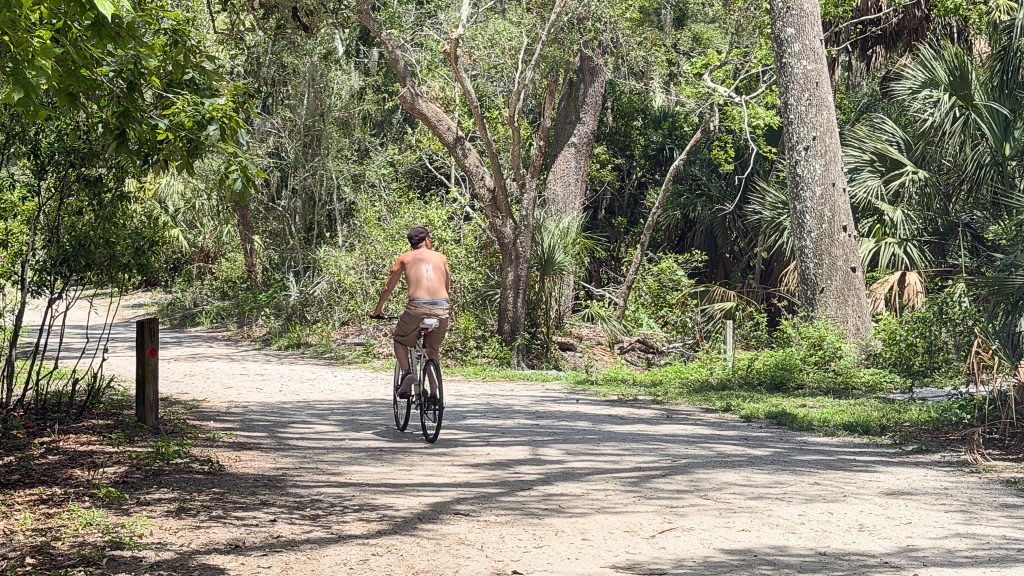
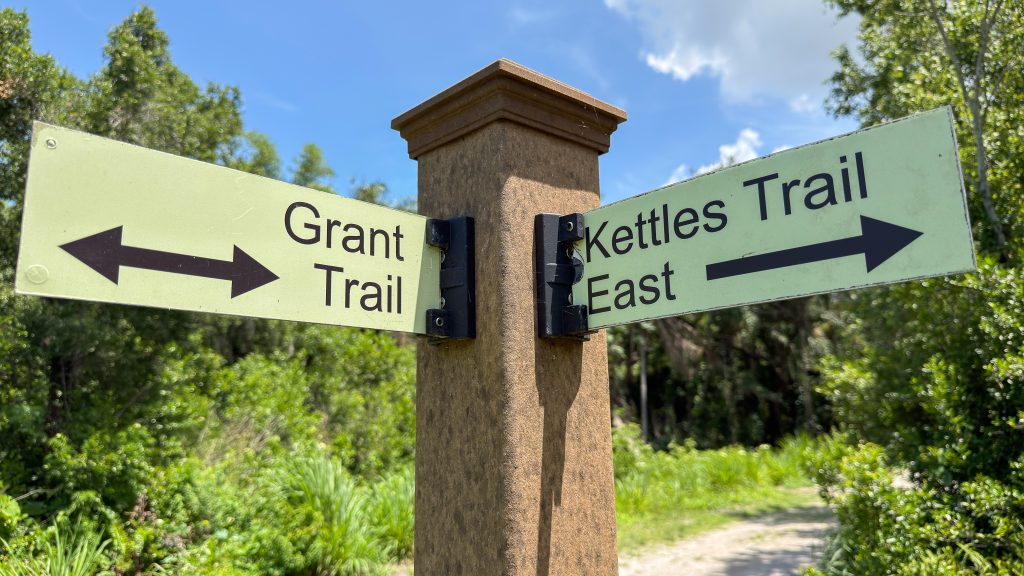
Hammock Park has approximately five miles of nature trails, organized into roughly twelve marked trail segments according to historical materials, with two boardwalks, five bridges, and an observation platform threading the system together. The trails connect into infinite combinations of loops, depending on which entrance you start from and how long you want to walk.
There are three main entrances. The largest parking area is off San Mateo Drive, at 1900 San Mateo, which puts you at the Butterfly Garden and at Andrews Memorial Chapel essentially right at the trailhead. A second entrance sits off Harvard Avenue. A third entrance sits off McCarty Street. The Florida Hikes directions also point visitors to two parking lots flanking the corner where the chapel stands. Wherever you start, you are within a quarter mile of three or four trail intersections, and the network burrows from there.
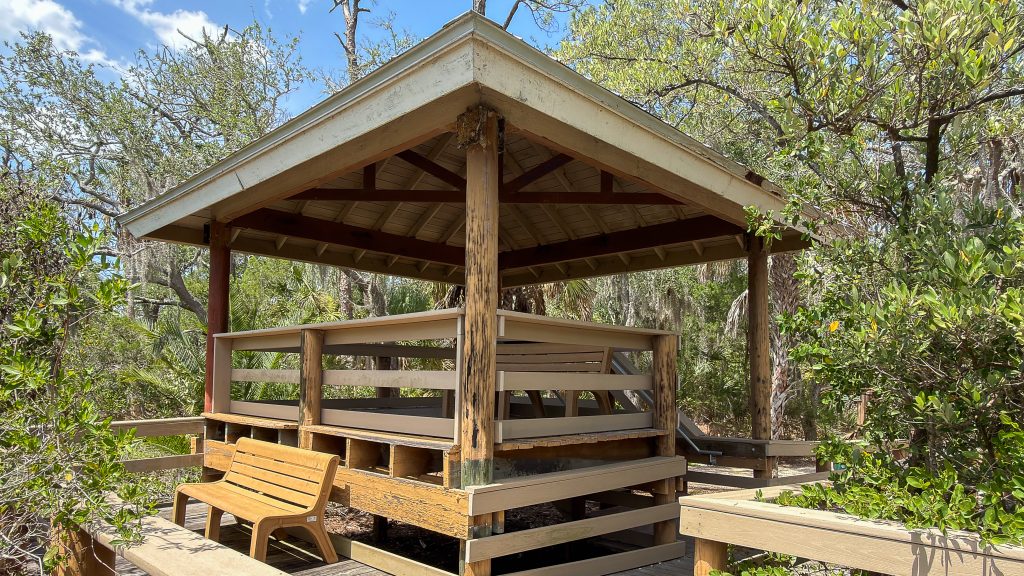
The trails are dirt and natural surface for the most part, with two boardwalk sections that carry walkers over the wetter habitats. The Fern Trail Boardwalk is one of the named segments. The observation platform sits at a location that gives you views across the canopy. The trails are maintained by local volunteers, not by paid city staff alone, which is part of why they have stayed in such consistent shape across decades.
For a casual walker, an hour through the park covers a reasonable loop. For a runner, the trails are technical enough to demand attention and varied enough to keep the same loop interesting on repetition. I have run them and walked them on probably hundreds of mornings and afternoons across more than a decade, and I still find new combinations and small things I had not noticed before.
The kiosks at the trail entrances hold a five-page guide to a 36-point interpretive nature trail, which is rated superior for an interpretive self-guided tour. The guide is worth picking up the first time you walk the park. It tells you what you are actually looking at, which trees are which, what the different habitats are doing, and what to listen for in the bird calls.
The Wildlife
If you walk Hammock Park regularly, the wildlife is the part that becomes part of your life.
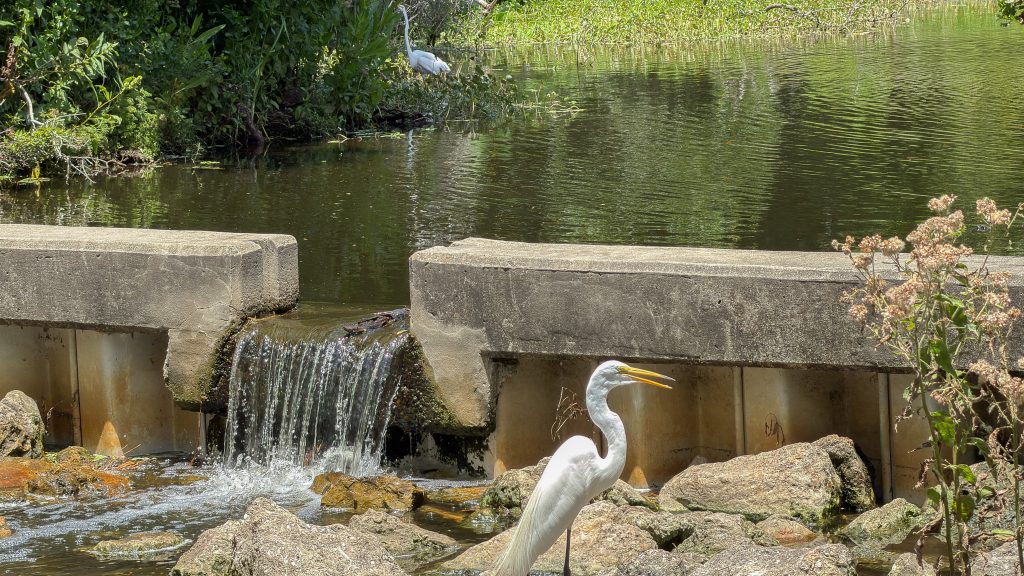
Wading birds, Osprey, and Barred Owl occur year round. Winter brings ducks, rails, sandpipers, and a variety of sparrows. The hammock’s hardwoods and sabal palms attract resident and migratory songbirds, including Brown Thrasher and White-eyed Vireo. Spring and fall migration windows bring wood-warblers through the park, and birders position themselves on the trails specifically to catch them.
Gopher tortoises are a significant presence in the park. The 2013 Hammock Management Plan identified 14 burrows mapped by GPS, with additional burrows on the park’s periphery. The 2017 acquisition of the adjacent church property expanded protected tortoise habitat by eight acres. In 2020, the Friends of the Hammock contracted with biologist George Heinrich of Heinrich Ecological Services to conduct an extensive tortoise survey following Florida Fish and Wildlife Conservation Commission guidelines, to estimate the population and guide habitat management. The Florida gopher tortoise is a keystone species, meaning its burrows support many other animals, so the work of protecting and growing the population in Hammock Park matters well beyond the species itself.
Beyond the tortoises and the birds, the park supports a substantial range of Florida wildlife. Squirrels, of course. Lizards. Snakes, including non-venomous species you will see crossing the trails and the occasional venomous species you should give space. Insects, in volume that varies dramatically by season. Butterflies, which the dedicated Butterfly Garden supports more intensely than the broader park. Raccoons and foxes that you mostly notice through evidence rather than direct sightings. Fish in the canals. Crabs in the mangrove edges.
What you see on any given walk depends on the season, the time of day, the weather, and whether you are moving fast or slow. The early mornings are the best time for birds. Late afternoons get the better light for photography. Cooler days bring out reptiles. Hot, still days are when the birds go quiet and the insects own everything.
The Butterfly Garden
The Butterfly Garden is one of the most distinctive features of the park, and it sits right at the San Mateo Drive entrance, so it is the first thing many visitors see.
The garden is described as home to more than thirty-five species of butterflies. It is a dedicated planted area, with native plants chosen specifically for the butterfly species they support. The work of keeping the garden functioning is volunteer-driven, with members of the Friends of the Hammock regularly working in it. The Butterfly Garden is also one of the park’s most popular spots for families and for visitors who want a contained, accessible piece of the park rather than a full trail walk.
The garden’s relationship to the broader park is worth understanding. The butterflies in the garden are not contained within it. They move through the surrounding hammock and pine groves and back. The garden is a concentration of habitat and food sources that supports the broader butterfly population across the entire park. When you walk the trails on a warm day and see butterflies along the way, many of them are part of the population the garden helps sustain.
The Disc Golf Course
Hammock Park has a disc golf course that uses the park’s natural terrain as the course design.
For disc golfers, the course is a real part of the park’s identity and is genuinely respected within the regional disc golf community. The course winds through wooded sections, uses elevation changes that you would not expect in a Florida park, and presents the kinds of obstacles, trees and undergrowth and shade and shifting wind, that disc golf was designed for.
For non-disc-golfers walking the park, the course is part of the landscape. The pins are positioned along sections of the park that the trails also use. You will see disc golfers on most days. The two uses coexist mostly without conflict, with the understanding that walkers should stay aware of the course when they are crossing through and that disc golfers stay aware of walkers.
The Playground, the Pavilions, and the Practical Amenities
Hammock Park is not only a nature preserve. It also functions as a working city park with the amenities that make a park usable for families.
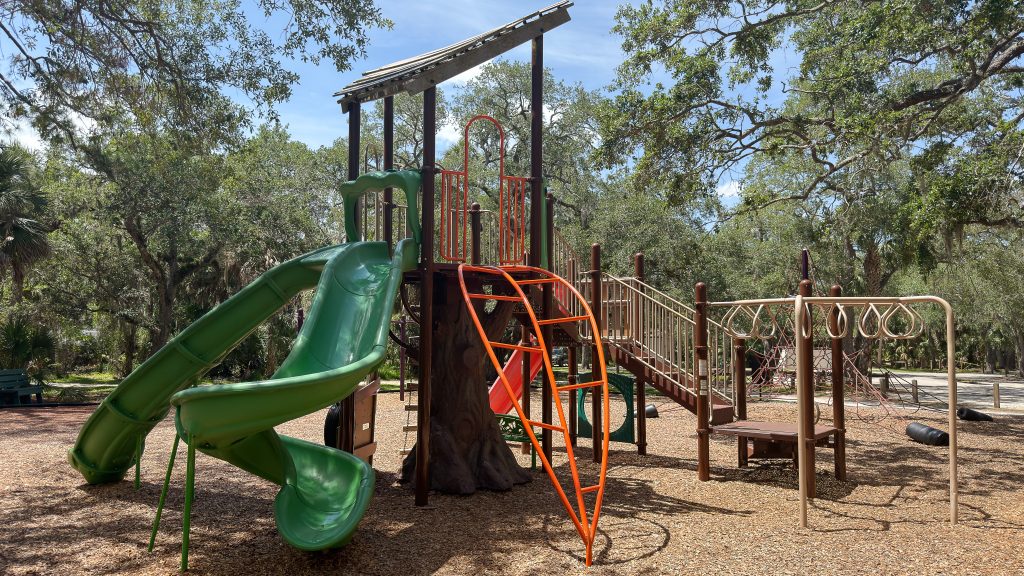
The playground is treehouse-themed, with climbers and swings, sized for younger children. It sits in one of the more open, sunlit sections of the park, with picnic facilities nearby. For families with kids, the playground is what makes Hammock Park a workable destination for a few hours on a weekend morning. Kids can climb and run while adults sit nearby in the shade.
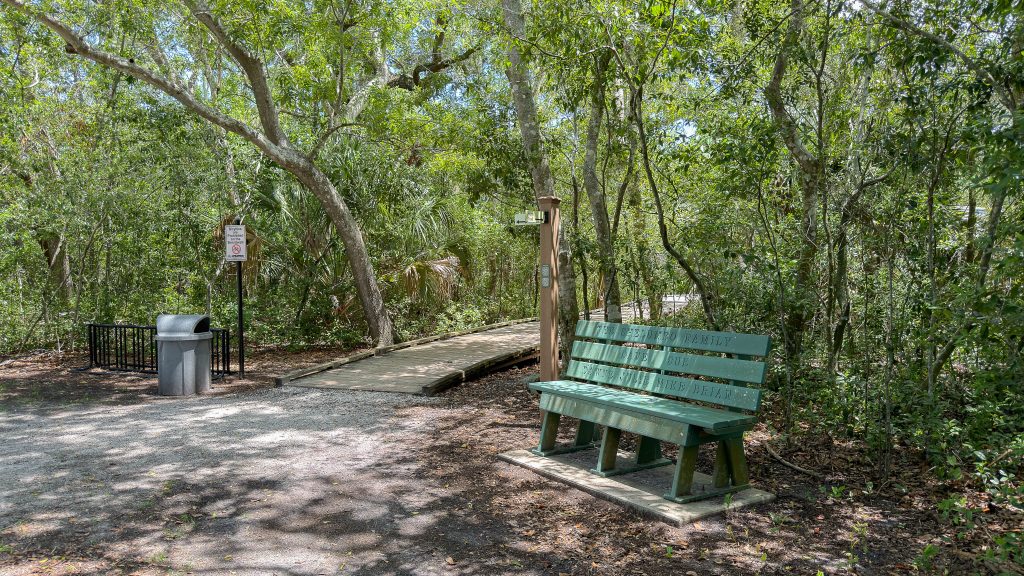
There are five picnic pavilions distributed across the park, with the larger ones holding multiple tables and accommodating birthday parties, family gatherings, and small community events. Restrooms are available, which is a practical detail that matters more than it sounds for a 90-acre park where walking the full trails takes well over an hour. Benches are placed throughout the park at intervals along the trails, giving walkers, runners, and birders places to rest, watch, and listen.
For visitors who use mobility aids or who cannot manage the rougher trails, an accessible Osprey Loop near the main parking area provides a flatter, more navigable option. The park is meant to be usable by everyone who lives in Dunedin or visits, not just by people who can hike rough terrain.
The People in the Park
What I value about Hammock Park, after more than a decade of walking and running it, is the people as much as the place.
On any given morning, you will see a particular cast of people who use the park the way I do. Runners moving through the trails at speed, training, in their own world. Walkers in pairs and threes, neighbors who have made the park part of their daily catch-up. Dog walkers along the more open trails. Birders, recognizable by their binoculars and their stillness, standing for long minutes at intersections waiting for something specific to call. Photographers with serious cameras working specific light. Parents with strollers on the more accessible loops. Disc golfers in their groups moving through the course. The occasional school field trip or summer day camp group, kids with field guides being led by a teacher or a counselor.
What that adds up to is a public space that genuinely functions as a community space. I see people I know almost every time I am there. Neighbors. Friends from civic groups. People I have not seen in months who use the park the same way I do and who I run into on the trail. That kind of community function in a public park is rarer than it should be in American cities, and it is one of the things that makes Hammock Park distinctive. The park is not just a nature preserve. It is part of how Dunedin sees itself, on the trails, in the early mornings and the late afternoons.
The Friends of the Hammock
A park does not stay a park on its own. Hammock Park has survived as the place it is partly because of an organization called the Friends of the Hammock, which has been doing the unglamorous and necessary work of supporting the park since 1995.
The Friends of the Hammock is a nonprofit, founded in 1995, dedicated to education, beautification, management, and charitable programs that benefit Hammock Park. The group is structured to operate alongside the park’s seven-member Advisory Committee, providing an organizational outlet for the many community members who want to be involved in the park’s well-being beyond the small Advisory Committee.
What the Friends actually do, in practical terms, is a long list. Members work regularly in the Butterfly Garden, planting, weeding, supporting the species the garden hosts. They organize and lead invasive plant removal events, where volunteers spend hours pulling air potato vines, Boston fern, and other invasive species that threaten the native habitats. They run fundraisers. They table at community events. They produce educational materials, including the brochures that have helped tell the park’s story over the years. They host an annual meeting that, in April 2025, marked the organization’s thirtieth anniversary.
Thirty years of monthly meetings, regular volunteer days, fundraising, education, and stewardship work is not a small thing. It is the cumulative civic effort that has kept a 90-acre nature preserve functioning as a usable park for the residents of a city. If you are a Dunedin resident who loves Hammock Park, joining the Friends of the Hammock is one of the most direct things you can do to support the park’s continued survival. The membership fees and the volunteer hours both matter.
The Friends meet the first Monday of each month, currently on Zoom. Their website is at hammockpark.org and at friendsofthehammock.wildapricot.org. They publish a newsletter three times a year. They welcome volunteers at all levels of involvement.
Dr. Blatchley, My Nature Nook, and the Deeper Story
The deeper story of Hammock Park is not contained inside the park’s boundaries. It connects to the broader natural history of Dunedin, which a man named Willis Stanley Blatchley was documenting from his property across town more than a century ago.
Blatchley was an Indiana naturalist who became a Dunedin snowbird in the early 1900s. He bought property on what is now Weaver Park, on the other side of downtown Dunedin from where Hammock Park sits today. On his property, on a leaning oak tree, he built a small platform that he called his nook. From that platform, across years of observation, he watched and recorded the natural and human life of early-1900s Dunedin. The birds, the fish, the insects, the trees, the plants, the people who lived in the small town the city was then. The town, in those years, had a population of about 1,700.
In 1931, Blatchley published his observations as a book titled “My Nature Nook: Or, Notes on the Natural History of the Vicinity of Dunedin Florida.” Three hundred and two pages of detailed natural history and Dunedin life, written from his platform in the oak. According to George Nigro, who chaired the eventual reprinting project, “it is the only written personal narrative, in existence, about life in Dunedin in the early part of the 1900s.” The book includes references to the people who lived and worked in Dunedin in that era, including Henry Scharrer of Hog Island fame, and notes on the Indian burial grounds on Hog Island and within Dunedin itself, archaeological observations that connect the work to the deeper Tocobaga history of the region.
The book went out of print and became extremely difficult to find. Surviving copies were time-worn and discolored. In the early 2010s, the Dunedin Historical Society undertook an ambitious project to reprint it. Under the leadership of curator Vinnie Luisi and committee chair George Nigro, the Society photographed every page, restored the text, and produced both 150 leather-bound limited edition copies and a paperbound edition. The leather on the limited edition was matched to the color of the oak tree at Weaver Park, the same kind of tree Blatchley had built his nook in. The first edition was presented to the City of Dunedin for posterity. The reprinting was completed in time for the holidays in 2012.
The book is available today at the Dunedin History Museum. The leather-bound limited editions were originally sold for $107 and a small number may still be available. Paperbound editions were sold for $27. For anyone genuinely interested in the natural and human history of Dunedin, the Museum is the place to go, and the book itself is one of the most distinctive artifacts in the city’s historical record.
What does this have to do with Hammock Park? Everything, and nothing direct.
Nothing direct in the sense that Blatchley did not write the book about Hammock Park. He wrote it from his Weaver Park property, about the natural environment surrounding his home and the broader vicinity of early-1900s Dunedin.
But everything in the deeper sense. The Florida that Blatchley was observing in the early 1900s, the hardwood hammocks and the mangrove swamps and the pine groves and the wading birds and the gopher tortoises and the wood-warblers passing through on migration, that Florida is exactly what Hammock Park preserves today. The 90 acres of Hammock Park are one of the last places in this city where you can walk through the same kinds of habitats Blatchley was documenting, see the same kinds of birds, hear the same kinds of sounds, stand in the same kind of Florida he stood in. Most of what surrounded his nook in the 1910s and 1920s is now subdivisions and roads. Hammock Park is what was left, because in 1965 a man named Ken Kerr chose preservation over development.
The book and the park are part of the same story. The story of a town that knew, in different generations, that its natural environment was worth preserving and recording. Blatchley recorded it in a 302-page book. The City of Dunedin and the Friends of the Hammock and Ken Kerr preserved it in 90 acres of land. The Dunedin Historical Society made Blatchley’s work available again to the residents of the city he loved.
You can read about it at the Dunedin History Museum. I have written about that museum, and about the chapel that sits at the entrance to Hammock Park and how the rescue of that chapel founded the Historical Society, in my piece on the Dunedin History Museum and Andrews Memorial Chapel. The connections between the museum, the chapel, the book, the park, and the broader civic fabric of Dunedin are not coincidences. They are what a town with a hundred and twenty-five years of continuous community commitment looks like.
How to Use Hammock Park
If you have not been to Hammock Park, here are the practical things to know.
The main entrance is at 1900 San Mateo Drive, with the Butterfly Garden and Andrews Memorial Chapel essentially at the trailhead. Two other entrances at Harvard Avenue and McCarty Street give you alternate access. Parking is free. The park is open during daylight hours.
For a first visit, allow at least an hour and a half. Walk to the Butterfly Garden first, then take one of the marked loops out into the hammock. Pick up the interpretive guide at the kiosk. Plan to come back, because one visit is not enough to see what the park actually offers.
Bring water. Bring sun protection if you are walking the more open sections. Bring closed-toe shoes if you are doing anything other than the most accessible paved loops, because the trails are real trails, with roots and uneven ground. Bring binoculars if you are remotely interested in birds. Bring a camera, because the light through the hardwood canopy is genuinely beautiful in the morning and late afternoon.
For families with young kids, the playground and the pavilions and the Butterfly Garden are enough for a couple of hours. For walkers and runners, the trails will keep you occupied for as long as you want to be there. For birders, the park is on the Great Florida Birding Trail and is one of the better birding sites in the area for both resident and migratory species. For photographers, the variety of habitats and the quality of the light reward repeat visits.
For supporters of the park beyond just using it, join the Friends of the Hammock. The hammockpark.org and friendsofthehammock.wildapricot.org websites have the information. Memberships are inexpensive. Volunteer opportunities are real and ongoing.
Why Hammock Park Matters
A 90-acre nature preserve in the middle of a city is a luxury that most American towns do not have and never will have.
The land had every reason to become subdivisions in the 1920s, like most of the rest of the Florida it surrounded. The mosquito ditches were already dug. The plats were drawn. The development plans were active. What stopped the land from becoming what it would have become was one attorney named Ken Kerr deciding, sometime between 1931 and 1965, that he loved the land too much to develop it. Then a city government willing to receive the gift. Then a 1972 expansion. Then a 2017 expansion. Then thirty years of Friends of the Hammock work, ongoing volunteer trail maintenance, invasive species removal, butterfly garden tending, gopher tortoise habitat management, and the steady cumulative effort of people who decided this place was worth keeping.
That is the only reason Hammock Park exists. Specific people making specific decisions across sixty years, with the cumulative effect of preserving 90 acres of Florida that would otherwise be gone.
For me personally, the park is part of how I live in Dunedin. I run and walk through it every single week. I have done so since I moved here in 2013. I have seen the trails change with the seasons through more than a decade of regular use. I have met neighbors there, talked with friends there, watched birds I had never seen before, photographed light I had not seen anywhere else. The park is woven into the rhythm of my weeks, and it is one of the parts of life in Dunedin that I would mourn the loss of most if it were ever gone.
Most people in Dunedin have not walked Hammock Park, or have not walked it recently. If you have not, go. Park at the San Mateo entrance. Walk through the Butterfly Garden. Pick a trail. See what is there. The 90 acres that one attorney saved sixty years ago are still here, still open, still alive, still being maintained by people who care about them. You live in the kind of town that has this. The least the rest of us can do is use it, support the Friends, and pass the knowledge of it on to anyone who has not yet found their way through the gate.
For more on the natural and historical fabric of Dunedin that surrounds and connects to Hammock Park, see the Dunedin Florida Parks Trails and Waterfront piece, my piece on Honeymoon Island and the storms that created Oystercatcher Key, my piece on the Dunedin History Museum where you can find Blatchley’s book, and the Andrews Memorial Chapel piece that tells the story of the chapel at the park’s entrance. To support the park directly, visit the Friends of the Hammock and consider joining or volunteering.
About the author
I am Mark Middleton. I have lived in Dunedin since 2013 and have walked and run through Hammock Park every single week of those years. It is one of my favorite places in this town, and the friends and neighbors I run into there are part of why I love this community as much as I do. I am also a Realtor with Compass, leading Middleton Tampa Bay, though my work on this site is about Dunedin itself rather than real estate. If you have stories about Hammock Park or about the Friends of the Hammock that you think this piece should have included, I would welcome hearing them.